









A few months ago, I was using a translation tool to read a Serbian travel article, and I kept seeing the phrase “Severna Dakota” pop up everywhere. At first I thought it was some kind of region I’d never heard of — like a historical territory, or maybe a part of Canada that I’d somehow missed in geography class.
I Googled it. Nothing convincing came up in English. I searched maps. Still nothing. I asked a friend who speaks Slovenian. She laughed.
“That’s just North Dakota,” she said. “Severna means north. It’s the same place.”
That was my first lesson in how a single language difference can make a completely familiar place look entirely mysterious. And honestly? Once I got over the confusion, I started actually researching North Dakota properly for the first time — and it turned out to be one of the more interesting rabbit holes I’ve gone down in a while.
So if you’re here because “Severna Dakota” showed up on a translated map, a foreign-language website, or a multilingual travel blog and you couldn’t figure out what it meant — you’re not alone. Let me clear this up completely, and then tell you why the actual place behind the name is worth knowing about.
What “Severna Dakota” Actually Means
The explanation is genuinely simple once you have it.
“Severna” is a Slavic word meaning “northern.” It appears in Serbian, Croatian, Slovenian, and related languages. “Dakota” stays the same — it’s a proper noun derived from the Dakota people, part of the larger Sioux nation, and it doesn’t get translated because it’s a cultural and historical name, not just a directional label.
Put them together: Severna Dakota = Northern Dakota = North Dakota.
It’s the same logic that explains why Germany is Deutschland in German, why Italy is Italia in Italian, or why Spain is España in Spanish. The place doesn’t change. The language wrapping around it does.
When online translation tools, multilingual encyclopedias, Serbian travel sites, or Slovenian language learning platforms mention “Severna Dakota,” they’re talking about the 39th state of the United States, sitting in the Upper Midwest, bordering Canada to the north and South Dakota to the south. Same place. Same geography. Just a different linguistic label.
The confusion often multiplies because automated translation systems sometimes leave the Slavic form in place even when rendering a page into English — which is how English speakers end up staring at an unfamiliar name that somehow feels like it should mean something.
Now that you know what it means, here’s the part that actually matters: the place behind the name.
North Dakota Is Not What Most People Think It Is
I’m going to say something that surprised me when I first started looking into it: North Dakota had 26.3 million visitors in 2024, with visitor spending exceeding $3.4 billion.
That’s not a small tourism story. That’s a state that people are actively choosing to visit — and a lot of them.
The problem is North Dakota has a branding problem in casual conversation. When Americans think of it at all, they picture flat land, cold winters, and not much else. That’s not accurate, and it’s worth correcting.
Here’s what North Dakota — Severna Dakota — actually contains:
The Real Landscape: Badlands, Bison, and Wide Sky
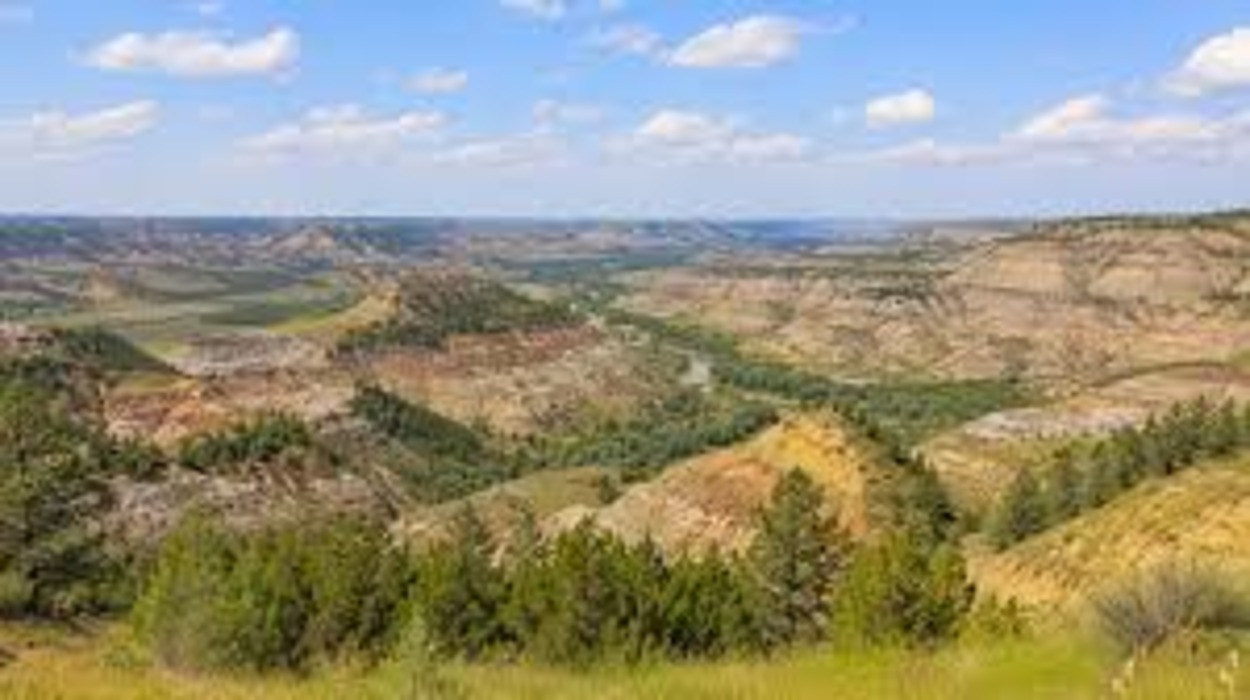
The western part of the state is where the landscape gets genuinely dramatic. Theodore Roosevelt National Park sits in the North Dakota Badlands, and it’s one of those places that photographs don’t fully capture.
The terrain here is all eroded buttes, twisting canyons, and layers of color in the rock that shift depending on the light. It looks more like something you’d find in the American Southwest than the Upper Midwest. And unlike Yellowstone or the Grand Canyon, it’s not usually crowded — which, depending on your travel preferences, is either a selling point or a flag.
The park is also one of the more reliable places in the country to see free-roaming bison up close. Not behind a fence — genuinely free-roaming, sometimes standing directly on the road. Prairie dogs, bighorn sheep, wild horses, coyotes — the wildlife density is real, and it catches first-time visitors off guard.
The Native American Heritage Is Central, Not a Side Note
The name “Dakota” comes from the Dakota people, part of the Sioux nation, and that heritage runs through every part of the state in ways that are still very much alive.
The Standing Rock Nation occupies land in both North and South Dakota. Communities like Cannon Ball, Fort Yates, and Porcupine maintain their own schools, cultural institutions, and governance. The UTTC International Powwow — held annually in Bismarck — is one of the largest outdoor powwows in the Northern Plains, drawing dancers, drummers, and spectators from across the region. Its 55th anniversary was celebrated in September 2025.
The Mandan people lived in the region long before European settlement, and the reconstructed Fort Mandan — where Lewis and Clark spent the winter of 1804-05 — sits near Washburn and offers a surprisingly immersive look at that period of exploration.
For anyone coming to North Dakota through the “Severna Dakota” search and wondering about cultural depth — it’s there. It’s not hidden. It just doesn’t get marketed aggressively enough.
The Immigrant Layers You Probably Didn’t Know About
Here’s something that genuinely caught me off guard.
North Dakota has one of the most distinctive European-immigrant cultural layers in the United States, and it came from an unusual combination of groups.
Norwegian and Icelandic immigrants settled the northeastern part of the state in significant numbers in the late 1800s. Their influence is still present in the food (lefse, lutefisk), place names, and annual festivals. The Icelandic State Park near Cavalier explicitly commemorates this heritage.
Then there are the Germans from Russia — ethnic Germans who had settled in Russia under Catherine the Great’s invitation in the 18th century, then emigrated to the Northern Plains (North Dakota, South Dakota, Kansas, Nebraska) before the turn of the 20th century. They brought their own distinct cultural mix — and their practice of marking graves with distinctive iron crosses, which you still see in cemeteries across rural North Dakota.
The result is a state with multiple immigrant cultural threads woven into a distinctly American landscape. It doesn’t look like what you’d expect, and that’s precisely why it sticks with you.
The Economy: Oil, Agriculture, and Quietly Thriving Cities
North Dakota leads the nation in oil production from the Bakken formation in the western part of the state. The oil boom of the 2010s transformed some communities almost overnight — turning small towns like Williston into boomtowns with housing shortages and 24-hour truck traffic.
Agriculture is the other pillar. More than 90% of North Dakota’s land is farmland — wheat, corn, soybeans, and sunflowers on a scale that’s hard to comprehend until you’ve actually driven through it. The state is among the top national producers of multiple crops.
The major cities — Fargo, Bismarck, Grand Forks, Minot — are thriving in quiet ways that don’t get covered in national media. Fargo in particular has developed a genuinely interesting food and arts scene, partly driven by the university population and partly by the energy that comes when a city stops waiting to be noticed and starts building things for itself.
Tourism hit a total economic impact of $5.7 billion in 2024. That number tells a different story than the “flyover state” narrative.
What to Actually Do There: A Practical Breakdown
If you’ve arrived at this article through “Severna Dakota” and are now actually considering visiting — here’s what’s worth your time, organized practically:
For outdoor and nature experiences:
- Theodore Roosevelt National Park (South and North units — do both if you can)
- Pembina Gorge State Park in the northeastern corner — a wooded, hilly landscape completely unlike the plains image, with expanded trails opening in late 2025
- Lake Sakakawea, one of the largest reservoirs in the US by surface area — boating, fishing, and shoreline camping
- The Enchanted Highway near Regent — a series of massive metal sculptures rising from the prairie, including a 110-foot dragon and 41-foot knight (grand opening expansion on July 4, 2026)
For history and culture:
- Fort Mandan State Historic Site near Washburn — Lewis and Clark’s winter camp, 1804
- North Dakota Heritage Center & State Museum in Bismarck — extensive collection covering Indigenous history through the present
- UTTC International Powwow in Bismarck (annual, usually September)
- Standing Rock cultural centers
For food and city life:
- Fargo’s downtown dining scene, which has expanded significantly
- Local lefse and kuchen (a German-Russian pastry) at bakeries in smaller towns
- Pheasant hunting season draws visitors from across the country every fall — if that’s your thing, this is one of the best places in North America for it
The Common Mistake: Assuming You’ve Seen It From the Highway
The biggest error people make with North Dakota — the thing I’d fix if I could tell every first-time visitor one thing — is driving through on I-94 and assuming that’s the state.
The interstate corridor is flat and agricultural, and it genuinely doesn’t prepare you for what’s in the Badlands, what’s along the Missouri River breaks, or what’s in the northeastern wooded corner near the Canadian border. These are completely different ecosystems and landscapes within the same state, and you won’t know any of them exist if you only follow the highway.
The same applies to the cultural history. Driving past Bismarck on the interstate gives you no sense of the depth of Native American and immigrant heritage that sits just off the main routes.
Slow down. Go west. Go northeast. Look for the places that aren’t on the first page of search results.
The Language Thing, Revisited
One last thing worth mentioning for anyone who came here through a genuine language curiosity.
The fact that “Severna Dakota” exists as a search term — that it’s gaining enough online traction to generate articles — is actually a useful window into how the internet handles multilingual content. When translation tools leave foreign-language place names untranslated, English speakers encounter terms that look new and mysterious but are simply familiar places in unfamiliar clothes.
It’s worth getting comfortable with that phenomenon. Italia is Italy. Deutschland is Germany. Severna Dakota is North Dakota. The places are the same. The linguistic packaging is just different — and once you see past the packaging, the real thing underneath is often more interesting than you expected.
North Dakota certainly was, for me.